


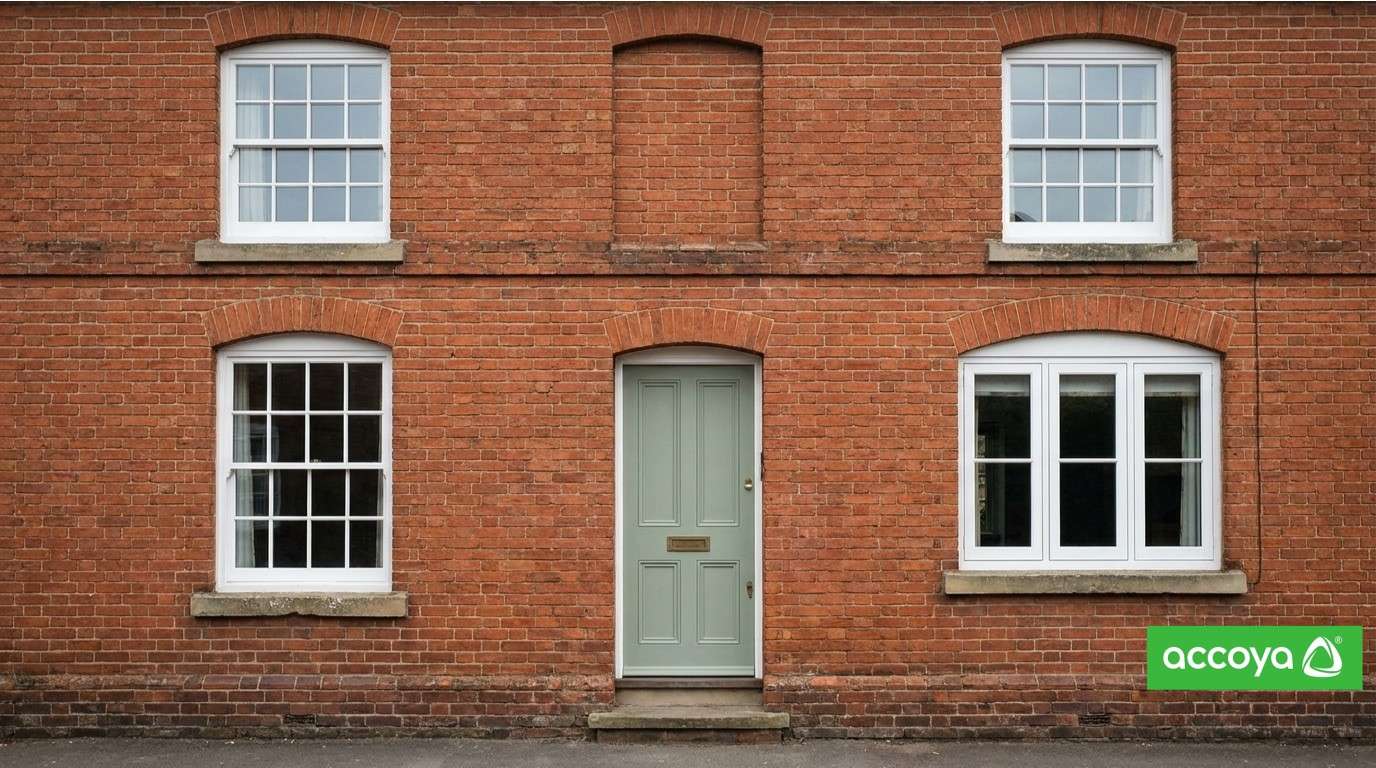
We started building windows and doors using Accoya back in 2010, which made us early adopters of the material in our part of the South East of England. Most timber joiners had not heard of Accoya back then. Now, more than fifteen years and a workshop full of it later, we have a very clear view of where it earns its keep, and what a homeowner in London and the Home Counties should actually expect from it. This is the practical version, written from the bench rather than the brochure.
What Accoya actually is
First things first, Accoya is not a new species of tree. It’s actually fast-growing radiata pine from FSC-certified forests, which is put through a process called acetylation. In plain terms, the wood is treated with acetic anhydride, which is closely related to the acetic acid in ordinary vinegar. That reaction targets the free hydroxyl groups in the timber (the parts of the wood that attract and hold water) and converts them into acetyl groups that do not attract or hold water. The result is a piece of wood that takes on far less moisture than it did as ordinary pine, and that single change is responsible for almost everything Accoya is known for.
Because it holds so little water, Accoya barely moves with the seasons and gives rot and insect attack very little to work with. It is rated Durability Class 1, the top of the scale used to measure a timber’s resistance to decay, which puts it alongside the best tropical hardwoods. Accoya’s manufacturer backs the material with a 50-year above-ground warranty and a 25-year warranty for in-ground or freshwater, and quotes an expected minimum service life of around 60 years. Those are the numbers we give to customers, and we’ve now had Accoya windows in the field long enough to trust them.
Why it suits a British home, and a sash window in particular
The British problem with timber windows has always been the weather. Damp can get into ordinary softwood, the timber swells, and the window starts to bind in its frame. Come summer, it dries, shrinks, and the joints open up. Accoya largely sidesteps that cycle. It swells and shrinks far less than conventional wood, so the window that ran smoothly in August still runs smoothly in February.
For a sliding sash, that matters more than it might sound. A box sash relies on fine tolerances and balanced weights to glide, and a few millimetres of seasonal movement is the difference between a sash you can lift with one finger and one you have to fight. With Accoya, we can hold those tolerances with confidence. The same stability is why it does well on exposed and coastal elevations across the South East, and why it copes with the humidity of a bathroom or kitchen where ordinary timber would struggle.
Why do we paint Accoya rather than stain it?
This is the piece of advice we give almost every customer, and it comes from our own experience finishing the material rather than from a datasheet. Accoya has natural grain variation, and a translucent stain tends to show that variation unevenly, so the finish can look patchy. A solid painted finish sits flat and consistent, and because Accoya is so stable, the paint is not being constantly stressed by a moving substrate. That means coatings last noticeably longer and crack far less than they would on standard softwood.
We finish our frames in three coats of microporous acrylic paint, white as standard or any colour you specify. Microporous is the important word: it lets the timber breathe and release moisture rather than sealing it under a film that eventually blisters. The result for the homeowner is a window or door that needs a light maintenance recoat every eight to ten years, rather than the annual upkeep older timber windows were known for.
Accoya in conservation areas and on listed buildings
A good deal of our work is in period properties, so this comes up constantly. The honest position is that Accoya does not give you an automatic pass. In a conservation area or on a listed building, what you can install is decided by your local planning authority, and a conservation officer may specify like-for-like detailing or, occasionally, a particular timber.
Where Accoya helps is that it machines cleanly to authentic period profiles, and we can match the glazing patterns that define each era: six-over-six for many Georgian windows, two-over-two for the later Victorian style, one-over-one for plainer Edwardian frames. We’ll always tell you what your designation is likely to allow before you commit, and we are used to having that conversation directly with planning officers.
What the building regulations actually require
If you are replacing windows in an existing home, this is the framework that applies, and it is worth getting right because a lot of confusing terms get thrown around. Replacement windows are notifiable work under the Building Regulations. The two parts that matter are Part L, which sets the thermal performance the window must meet, and Part F, which covers ventilation and explains why trickle vents are fitted where they are needed.
Part L is met mainly through the glazing and the sealed unit rather than the frame alone, which is where your glass specification comes in. Completed work for full replacements including frames is certified through FENSA, the competent person scheme for windows. Terms you may have read about, such as PAS 24 and Part Q, relate to security requirements in new builds and do not necessarily apply to like-for-like replacements in an existing home, so do not let anyone use them to sell you something you do not need.
The environmental case, without the marketing
Timber has a real environmental advantage over plastic here, but it is worth stating it accurately rather than reaching for the biggest number. A life-cycle assessment of window materials by Napier University in Edinburgh found that manufacturing a timber window frame used around 955 megajoules of energy, compared with roughly 2,980 megajoules for uPVC and about 6,000 megajoules for aluminium. So, a timber frame carries roughly a third of the embodied energy of an equivalent plastic one, and the lowest embodied carbon of the common frame materials. Add to that the fact that Accoya comes from responsibly managed, fast-growing forests, is non-toxic, fully recyclable and certified Cradle to Cradle at Gold level, and the case stands on its own without exaggeration. A uPVC window, by contrast, is an oil-derived product that tends to be replaced rather than repaired.
Why it matters who makes and fits it
Accoya rewards precise work. It machines well and holds a joint, but it wants careful sealing and accurate fitting to perform as intended over decades. We design, manufacture, and install in-house, which is less common than people assume. Our windows and doors are built in our purpose-built workshops in Guildford and fitted by our own full-time joiners rather than subcontractors, so the business accountable for how a window performs in your wall is the same one that built it.
As well as clear and super energy-efficient Softcoat double glazing and low E glass, we can also use privacy glass for overlooked and bathroom areas where required, using Barron Glass and Pilkington Glass; we draught-seal as standard with Brush and Aquamac seals, and you can see finished examples at our showroom in Cobham, Surrey.
We have been manufacturing and installing timber windows and doors since August 1999, and our promise has not changed: if something is not right, however small, we come back and put it right.
If you are weighing up replacement traditional sash windows, wooden casement windows or a new timber front door and want to know whether Accoya is the right call for your property, we’re happy to talk it through with no obligation.
Call the Sash Window Specialist on 0800 389 7384
* Planning rules vary between local authorities, and conservation area and listed building requirements can change. Always confirm your property’s planning status with your local authority before ordering replacement windows, and ask any supplier for their guarantee and compliance documentation in writing.